Cross-Platform Attribution Modeling: Track Customers Across Every Device and Channel
Your customer sees an Instagram ad on mobile, googles you on desktop, reads reviews on tablet, and buys on phone. That's 4 devices, 3 channels, 1 customer. Here's how to track the full journey and attribute revenue correctly.
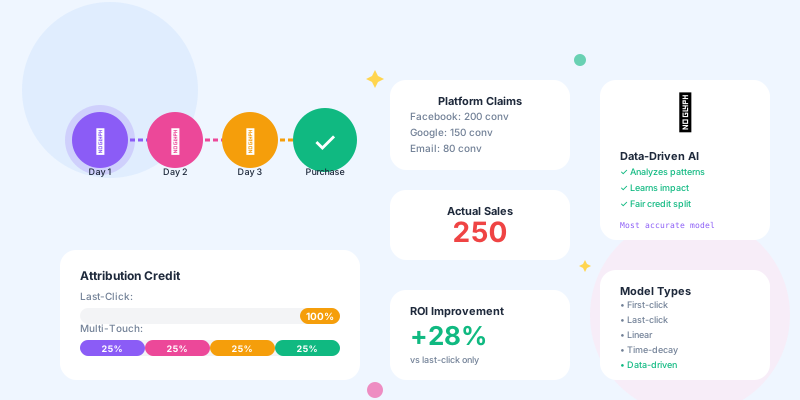
Single-device attribution is dead. The average customer uses 3.2 devices before purchasing. Your analytics platform only sees disconnected sessions from anonymous users. You need cross-platform attribution that stitches together the full customer journey—or you're making decisions based on incomplete data.
Why Cross-Platform Attribution Matters
The Multi-Device Reality
Typical customer journey in 2026:
What Gets Measured Wrong
Without cross-platform attribution:
- Last-click attribution: Email gets 100% credit (ignores Instagram ad, Google search, Facebook retargeting)
- Channel performance: Undervalues upper-funnel channels (social, display)
- Device data: Can't compare mobile vs desktop conversion paths
- Customer journey: Fragmented, incomplete picture
- Budget allocation: Based on partial data, optimizing the wrong channels
Cross-Platform Tracking Methods
1. User ID Tracking (Most Accurate)
Connect sessions when user logs in:
- User creates account or logs in
- Assign permanent User ID
- Track all sessions under same User ID across all devices
- Stitch together complete journey
// Set User ID when user logs in
analytics.identify('user_12345', {
  email: 'user@example.com',
  name: 'Sarah Chen',
  signupDate: '2026-01-15'
});

// Track events with User ID
analytics.track('Product Viewed', {
  userId: 'user_12345',
  product: 'Running Shoes',
  device: 'mobile',
  session: 'session_abc123'
});

// All future events automatically tied to user_12345
// Works across mobile app, mobile web, desktop, tablet
2. Cross-Device Fingerprinting
Probabilistic matching based on signals:
- IP address: Same home IP across devices
- User agent patterns: Similar browser/OS characteristics
- Browsing behavior: Similar pages visited, timing patterns
- Location data: Consistent geographic location
- Timestamp patterns: Sequential activity across devices
3. Email Graph Matching
Connect devices through email activity:
- User clicks email link on phone → Cookie set with email hash
- User later visits site on desktop → Different cookie
- User enters email at checkout → Connects both devices to same email
- Retroactively stitch journeys together
4. Google Analytics 4 Cross-Device Tracking
GA4 automatically tracks cross-device when users are logged in to Google:
// Enable User-ID feature in GA4
gtag('config', 'G-XXXXXXXXXX', {
  user_id: 'user_12345'
});

// GA4 also uses Google Signals for cross-device
// (when users signed into Google across devices)
gtag('config', 'G-XXXXXXXXXX', {
  allow_google_signals: true
});Attribution Models Explained
Single-Touch Attribution Models
Multi-Touch Attribution Models
- Analyze all customer journeys
- Compare paths that converted vs didn't
- Calculate each touchpoint's incremental impact
- Assign credit proportionally
Implementing Cross-Platform Attribution
Step 1: Data Collection Infrastructure
// Unified tracking across all platforms

// Mobile App (iOS)
Analytics.shared.identify(userId: "user_12345")
Analytics.shared.track(name: "Product Viewed", properties: [
  "device": "iPhone 15 Pro",
  "platform": "iOS",
  "product_id": "SKU123"
])

// Mobile Web
analytics.identify('user_12345');
analytics.track('Product Viewed', {
  device: 'mobile',
  platform: 'web',
  product_id: 'SKU123'
});

// Desktop Web
analytics.identify('user_12345');
analytics.track('Product Viewed', {
  device: 'desktop',
  platform: 'web',
  product_id: 'SKU123'
});

// All events flow to unified data warehouse
// with same user_id and standardized schema
Step 2: User Identity Resolution
Merge different identifiers into single customer profile:
class UserIdentityGraph {
  async mergeIdentities(identifiers) {
    // identifiers = [
    //   { type: 'email', value: 'user@example.com' },
    //   { type: 'phone', value: '+1234567890' },
    //   { type: 'cookie', value: 'cookie_abc123' },
    //   { type: 'device_id', value: 'device_xyz789' }
    // ]

    // Find existing user profile matching any identifier
    const existingProfiles = await db.findProfilesByIdentifiers(identifiers);

    if (existingProfiles.length === 0) {
      // Create new unified profile
      return await db.createProfile({
        userId: generateUserId(),
        identifiers: identifiers,
        devices: [],
        sessions: []
      });

    } else if (existingProfiles.length === 1) {
      // Add new identifiers to existing profile
      return await db.updateProfile(existingProfiles[0].userId, {
        identifiers: [...existingProfiles[0].identifiers, ...identifiers]
      });

    } else {
      // Multiple profiles found - merge them
      const primaryProfile = existingProfiles[0];
      const mergedIdentifiers = existingProfiles.flatMap(p => p.identifiers);
      const mergedSessions = existingProfiles.flatMap(p => p.sessions);

      // Update primary profile with merged data
      await db.updateProfile(primaryProfile.userId, {
        identifiers: mergedIdentifiers,
        sessions: mergedSessions
      });

      // Delete duplicate profiles
      await db.deleteProfiles(existingProfiles.slice(1));

      return primaryProfile;
    }
  }
}
Step 3: Session Stitching
Connect anonymous sessions to user after identification:
async function stitchSessions(userId, newIdentifier) {
  // Find all anonymous sessions with matching identifier
  const anonymousSessions = await db.findSessions({
    userId: null,
    identifiers: { contains: newIdentifier }
  });

  // Attribute sessions to user
  for (const session of anonymousSessions) {
    await db.updateSession(session.id, {
      userId: userId,
      stitchedAt: new Date(),
      stitchedBy: newIdentifier
    });

    console.log(`Stitched session ${session.id} to user ${userId}`);
  }

  // Rebuild customer journey with newly stitched sessions
  await rebuildCustomerJourney(userId);
}Step 4: Attribution Calculation
Calculate credit for each touchpoint:
class AttributionEngine {
  async calculateAttribution(userId, conversionEvent) {
    // Get all touchpoints leading to conversion
    const journey = await db.getCustomerJourney(userId, {
      endingWith: conversionEvent.id,
      lookbackWindow: 30 // days
    });

    // Apply attribution model
    const attributionModel = 'time_decay'; // or 'linear', 'first_touch', etc.

    const attributedTouchpoints = this.applyModel(journey.touchpoints, attributionModel);

    // Store attribution
    await db.saveAttribution({
      userId,
      conversionId: conversionEvent.id,
      revenue: conversionEvent.revenue,
      touchpoints: attributedTouchpoints
    });

    return attributedTouchpoints;
  }

  applyModel(touchpoints, model) {
    switch (model) {
      case 'first_touch':
        return this.firstTouch(touchpoints);

      case 'last_touch':
        return this.lastTouch(touchpoints);

      case 'linear':
        return this.linear(touchpoints);

      case 'time_decay':
        return this.timeDecay(touchpoints);

      case 'position_based':
        return this.positionBased(touchpoints);

      default:
        throw new Error(`Unknown attribution model: ${model}`);
    }
  }

  timeDecay(touchpoints) {
    // Give exponentially more credit to recent touchpoints
    const halfLife = 7; // days
    const totalWeight = touchpoints.reduce((sum, tp) => {
      const daysAgo = (Date.now() - tp.timestamp) / (1000 * 60 * 60 * 24);
      return sum + Math.exp(-daysAgo / halfLife);
    }, 0);

    return touchpoints.map(tp => {
      const daysAgo = (Date.now() - tp.timestamp) / (1000 * 60 * 60 * 24);
      const weight = Math.exp(-daysAgo / halfLife);
      return {
        ...tp,
        attributionCredit: weight / totalWeight
      };
    });
  }

  positionBased(touchpoints) {
    // 40% first, 40% last, 20% distributed to middle
    if (touchpoints.length === 1) {
      return [{ ...touchpoints[0], attributionCredit: 1.0 }];
    }

    if (touchpoints.length === 2) {
      return [
        { ...touchpoints[0], attributionCredit: 0.5 },
        { ...touchpoints[1], attributionCredit: 0.5 }
      ];
    }

    const middleCredit = 0.20 / (touchpoints.length - 2);

    return touchpoints.map((tp, index) => {
      let credit;
      if (index === 0) credit = 0.40; // First
      else if (index === touchpoints.length - 1) credit = 0.40; // Last
      else credit = middleCredit; // Middle

      return { ...tp, attributionCredit: credit };
    });
  }
}
Cross-Platform Journey Analysis
Identifying Common Paths
Analyze which device/channel sequences lead to conversions:
async function analyzeConversionPaths() {
  const conversions = await db.getConversions({
    dateRange: 'last_30_days'
  });

  const pathCounts = {};

  for (const conversion of conversions) {
    const journey = await db.getCustomerJourney(conversion.userId, {
      endingWith: conversion.id
    });

    // Create path signature
    const path = journey.touchpoints
      .map(tp => `${tp.channel}-${tp.device}`)
      .join(' → ');

    // Count occurrences
    pathCounts[path] = (pathCounts[path] || 0) + 1;
  }

  // Sort by frequency
  const topPaths = Object.entries(pathCounts)
    .sort(([, a], [, b]) => b - a)
    .slice(0, 10);

  return topPaths;
}

// Example output:
// [
//   ['instagram-mobile → google-desktop → email-mobile → direct-mobile', 234],
//   ['facebook-mobile → direct-desktop', 187],
//   ['google-desktop → direct-desktop', 156],
//   ...
// ]
Device-Switching Analysis
- Device switch rate: % of journeys involving multiple devices
- Primary discovery device: Which device users first interact on
- Primary conversion device: Which device final purchase happens on
- Average devices per journey: Complexity of cross-device paths
- Time between devices: How quickly users switch devices
async function analyzeDeviceSwitching() {
  const journeys = await db.getCustomerJourneys({
    hasConversion: true,
    dateRange: 'last_30_days'
  });

  const deviceAnalysis = {
    singleDevice: 0,
    multiDevice: 0,
    discoveryDevices: {},
    conversionDevices: {},
    averageDevicesPerJourney: 0
  };

  for (const journey of journeys) {
    const devices = new Set(journey.touchpoints.map(tp => tp.device));

    if (devices.size === 1) {
      deviceAnalysis.singleDevice++;
    } else {
      deviceAnalysis.multiDevice++;
    }

    // Track discovery device (first touchpoint)
    const discoveryDevice = journey.touchpoints[0].device;
    deviceAnalysis.discoveryDevices[discoveryDevice] =
      (deviceAnalysis.discoveryDevices[discoveryDevice] || 0) + 1;

    // Track conversion device (last touchpoint)
    const conversionDevice = journey.touchpoints[journey.touchpoints.length - 1].device;
    deviceAnalysis.conversionDevices[conversionDevice] =
      (deviceAnalysis.conversionDevices[conversionDevice] || 0) + 1;

    deviceAnalysis.averageDevicesPerJourney += devices.size;
  }

  deviceAnalysis.averageDevicesPerJourney /= journeys.length;
  deviceAnalysis.deviceSwitchRate = deviceAnalysis.multiDevice / journeys.length;

  return deviceAnalysis;
}

// Example output:
// {
//   singleDevice: 1234,
//   multiDevice: 2876,
//   deviceSwitchRate: 0.70, // 70% of journeys involve multiple devices
//   discoveryDevices: { mobile: 2891, desktop: 1219 },
//   conversionDevices: { mobile: 2456, desktop: 1654 },
//   averageDevicesPerJourney: 2.3
// }Privacy and Compliance
GDPR and Privacy Regulations
- Explicit consent: Inform users about cross-device tracking, get consent
- Anonymization: Hash identifiers before storing (can't reverse to PII)
- Data minimization: Only collect necessary tracking data
- Right to deletion: Allow users to request data deletion
- Transparency: Clear privacy policy explaining tracking methods
- Opt-out mechanism: Easy way to disable cross-device tracking
Privacy-First Attribution
Implement attribution without compromising privacy:
// Hash identifiers before storage
function hashIdentifier(identifier) {
  return crypto
    .createHash('sha256')
    .update(identifier + process.env.SALT)
    .digest('hex');
}

// Store only hashed versions
await db.createSession({
  sessionId: generateId(),
  userHash: hashIdentifier(email), // Not actual email
  deviceHash: hashIdentifier(deviceId),
  events: [...],
  timestamp: Date.now()
});

// Can still connect sessions with same hash
// But can't reverse hash to identify actual userTools and Platforms
Enterprise Attribution Solutions
- Google Analytics 4: Free, cross-device with Google Signals, data-driven attribution
- Adobe Analytics: Enterprise-grade, device co-op for cross-device matching
- Segment: Customer data platform with identity resolution
- AppsFlyer: Mobile attribution specialist, deep linking, fraud prevention
- Branch: Mobile-first attribution, cross-platform deep linking
- Mixpanel: Product analytics with cross-platform user tracking
- Amplitude: Product analytics, behavioral cohorts, user journeys
Building Custom Attribution System
For complex needs, build custom solution:
- Data collection: Segment, mParticle, or custom tracking SDK
- Data warehouse: Snowflake, BigQuery, Redshift
- Identity resolution: LiveRamp, Neustar, or custom graph database
- Processing: Apache Spark, dbt for data transformation
- Attribution logic: Python/R for model implementation
- Visualization: Looker, Tableau, Metabase for reporting
Common Pitfalls and Solutions
- Pitfall: Over-attributing to last click
Solution: Implement multi-touch model, value awareness channels - Pitfall: Attribution window too short
Solution: Extend to 30-90 days for considered purchases - Pitfall: Ignoring offline touchpoints
Solution: Include phone calls, store visits, direct mail - Pitfall: Not tracking anonymous journeys
Solution: Use cookies/fingerprinting, stitch when user identifies - Pitfall: Treating all conversions equally
Solution: Weight by revenue, lifetime value, profit margin - Pitfall: Static attribution model
Solution: Test multiple models, use data-driven when possible - Pitfall: Poor data quality
Solution: Validate tracking, deduplicate events, handle missing data - Pitfall: No cross-team alignment
Solution: Educate stakeholders, standardize attribution methodology
Actionable Insights from Attribution
Budget Reallocation
Use attribution to optimize spend:
// Calculate channel ROI with multi-touch attribution
const channelROI = await db.query(`
  SELECT
    channel,
    SUM(attribution_credit * revenue) as attributed_revenue,
    SUM(cost) as total_cost,
    (SUM(attribution_credit * revenue) / SUM(cost)) as roi
  FROM attribution_data
  WHERE conversion_date >= NOW() - INTERVAL '30 days'
  GROUP BY channel
  ORDER BY roi DESC
`);

// channelROI = [
//   { channel: 'google-search', attributed_revenue: 145000, cost: 32000, roi: 4.53 },
//   { channel: 'instagram', attributed_revenue: 89000, cost: 28000, roi: 3.18 },
//   { channel: 'email', attributed_revenue: 67000, cost: 5000, roi: 13.4 },
//   { channel: 'display', attributed_revenue: 23000, cost: 18000, roi: 1.28 }
// ]

// Insight: Email has highest ROI but smallest budget → increase investment
Journey Optimization
Identify and fix broken paths:
// Find paths with high abandonment
const abandonedPaths = await db.query(`
  SELECT
    path,
    COUNT(*) as occurrences,
    SUM(CASE WHEN converted = true THEN 1 ELSE 0 END) as conversions,
    (SUM(CASE WHEN converted = true THEN 1 ELSE 0 END)::float / COUNT(*)) as conversion_rate
  FROM customer_journeys
  WHERE last_touchpoint_date >= NOW() - INTERVAL '30 days'
  GROUP BY path
  HAVING COUNT(*) > 50
  ORDER BY conversion_rate ASC
  LIMIT 10
`);

// Identify low-converting paths to optimize
Cross-Platform Attribution Checklist
- ✅ Implement user ID tracking across all platforms
- ✅ Set up cross-device identity resolution
- ✅ Define attribution lookback window (30-90 days)
- ✅ Choose primary attribution model(s)
- ✅ Instrument tracking on mobile app, mobile web, desktop
- ✅ Stitch anonymous sessions when users identify
- ✅ Store complete customer journeys in data warehouse
- ✅ Calculate attribution for all conversion events
- ✅ Build reports for channel performance with attribution
- ✅ Analyze device-switching patterns
- ✅ Ensure GDPR/privacy compliance
- ✅ Educate team on attribution methodology
- ✅ Regularly audit data quality and accuracy
- ✅ Test multiple attribution models, compare results
- ✅ Use insights to optimize marketing spend
Conclusion
Cross-platform attribution is complex but essential. Your customers don't live in a single-device world—your analytics shouldn't either. The average customer journey spans 3+ devices, multiple channels, and several days. Without cross-platform attribution, you're making multi-million dollar marketing decisions based on incomplete data.
Start with user ID tracking for logged-in users. Add fingerprinting for anonymous journeys. Implement identity resolution to stitch sessions together. Choose attribution models that reflect your business reality. Build reports that show the full customer journey, not just the last click.
The reward: accurate channel ROI, optimized marketing spend, better customer understanding, and significantly higher revenue. Cross-platform attribution isn't optional anymore—it's the foundation of data-driven marketing.